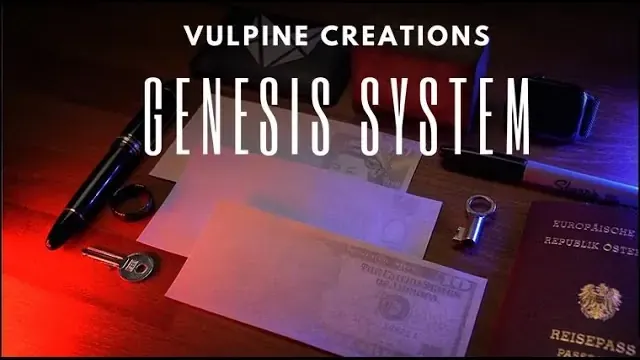
What it is
The idea started with a question Adam kept being asked: if you’re a magician, make money appear. He wanted to pull out a blank piece of paper and let someone watch a bill arrive on it — like CGI, without the camera.
Genesis takes friction ink and turns it inside out. Friction pens let you write something and make the ink vanish with heat, and it will not come back without a freezer. Genesis does the opposite: a sheet shown blank on both sides, and ink that appears.
The kit includes self-printing bills, self-printing playing cards and self-printing silhouettes, plus four complete routines — a treasure map that draws itself and then tracks footprints to the island the spectator chose; a voodoo piece where a bloodstain surfaces on a printed palm and again on their own hand; a Clue routine predicting a freely chosen character and weapon; and a walk-around confabulation that needs four sheets of paper and a Sharpie.
Nothing here is bigger than a few pieces of paper, and all of it plays large.
How it was made
The constraint was manufacturing. The process required handwork on every individual sheet, and the tolerances were unforgiving. Outsourcing was not feasible — no commercial manufacturer would take the process on — so every unit was produced by hand. Over twelve thousand sheets.
Genesis sold out immediately. The demand confirmed what Vulpine had suspected: the market wanted products manufactured to the highest standard rather than the lowest cost. A five-hundred-unit Genesis 2.0 followed.
Where it is now
The labour required per unit eventually made further production runs unsustainable. Some products are limited not by demand but by the physical reality of making them.